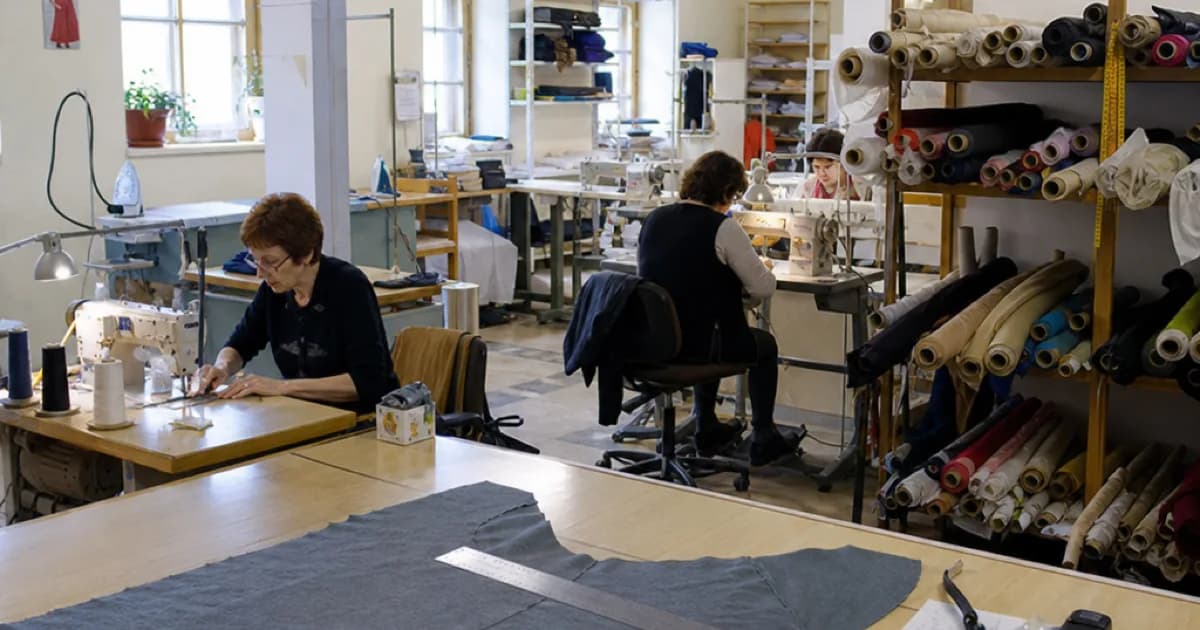
Supply chain
How to make merch: the full playbook, brief to boxes
What it actually takes to make merch: writing a spec, print-on-demand versus a real run, sampling, MOQs, quality control, landed cost and fulfillment.
 LukeSupply chain6 min read
Most people who set out to make merch start in the wrong place. They open a design tool, make a graphic, and then go looking for someone to put it on a hoodie. That order is why so much merch ends up as a box of unsold garments in somebody’s spare room.
The graphic is the easy part. What decides whether merch works is a set of unglamorous decisions made before anyone draws anything.
1. Decide which of the two you are doing
Be honest about this before anything else, because everything downstream follows from it.
| Print on demand | A real production run | |
|---|---|---|
| Up-front cost | Effectively none | Real money, paid before you sell |
| Unit cost | Highest | Falls with volume |
| Product | Someone else’s blank | Yours, spec’d by you |
| Speed to first item | Days | Weeks |
| Ceiling | Low margin forever | The one real brands operate at |
Print on demand is the right answer when you are testing whether anyone wants the thing at all. It is the wrong answer the moment you know they do, because you are permanently paying a premium for the privilege of not committing.
A real run is the right answer when you have demand, or when the product itself is the point and a stock blank cannot carry it.
2. Write the spec before you contact anyone
The single biggest mistake is emailing manufacturers with “we want to make t-shirts, what can you do?”. Every manufacturer hears that fifty times a week and answers it identically: they push you toward whatever is already on their line.
Key points
- Garment, the actual construction, not the vibe. Cut, fit, weight in GSM, fabric composition
- Decoration, screen print, embroidery, dye sublimation, applique. Each has different minimums and different failure modes
- Colours, as Pantone references, not as “off-white”. “Off-white” is four different colours depending on who is reading it
- Sizing, a full size run with measurements, not S-M-L
- Packaging, polybag, hangtag, care label. Decided now, not after
- Quantity and target landed cost, so quotes are comparable
A spec this specific does two things. It gets you comparable quotes, and it tells the factory you are not a tourist, which changes how seriously they take the enquiry.
3. Get more than one quote, from more than one factory
A single quote is not a price. It is a number with no context.
This matters more than it sounds, because of who you are usually talking to. A sourcing agent works with their factory. They are not neutral, and they are not lying to you either. They genuinely think their factory is the right one, because it is the only one they have. The quote you get back is the only quote that could have come back.
The comparison is the product. One number is a guess dressed as a price.
The spread between factories on the same spec is routinely wide enough to change whether the project is viable. You only find that out by asking more than one.
4. Sample. Always. Even when it is annoying.
Nobody should commit to a production run of something they have never touched. A sample tells you things no spec sheet does: how the fabric behaves, whether the print sits right on the actual garment, whether the fit matches the measurements you were sent.
Expect to iterate. The first sample being wrong is normal, not a red flag. It is what the sample is for. What matters is how the factory responds to the correction.
If a manufacturer resists sampling, or wants to skip straight to the run, that is your answer about them.
5. Quality control happens at the factory, not at your door
This is where most merch projects quietly go wrong.
Inspecting goods when they arrive at your warehouse means the defects have already been paid for, packed, shipped and cleared through customs. The fix at that point is a re-run and another six weeks, or selling something you are not happy with.
Checked at the factory on the samples and again on the run, a bad batch costs a re-run. Caught in your warehouse, it costs the season.
6. Landed cost is the only number that matters
The unit price a factory quotes is not what your merch costs. Landed cost is:
- Unit price
- Freight
- Duties and customs clearance
- Warehousing
- Pick, pack and outbound shipping
- The returns you will get
Brands that budget on the factory quote and discover the rest afterwards are the ones whose merch turns out to have negative margin. Work backwards from the retail price you can actually charge, not forwards from the quote.
7. Then the half nobody plans for
Once the goods exist, you still need somewhere to put them, someone to ship them, the right customs paperwork, sales tax collected in the right jurisdictions, and a process for what comes back. That is merch fulfillment, and it is usually assembled from four or five separate vendors, none of whom owns the delivery date.
It is the least interesting part of making merch and the part most likely to be the reason a customer never gets their order.
The short version
Decide what kind of merch you are making. Write a real spec. Compare several quotes. Sample before you commit. Check at the factory. Budget in landed cost. Plan the fulfillment before the goods land, not after.
The graphic still matters. It is just not the part that decides whether this works.
Frequently asked
It depends on what you are making, how much of it, and where. The variables that move the number most are quantity, decoration method and fabric, not the design. Rather than trust one quote, put the same spec in front of several manufacturers and compare what comes back; the spread tells you more than any single figure.
Your own merch, in production in 5 minutes.
Adaptive storefronts on top, the whole supply chain underneath. Ship without managing the stack.